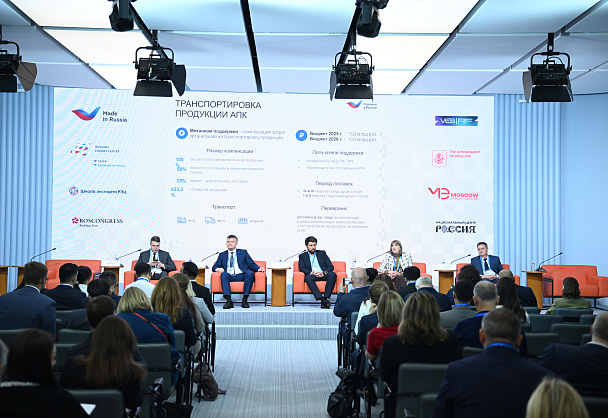
In the context of global trade restructuring and increased competition, the role of effective tools for promoting domestic products in international markets is becoming crucial. On October 21, Russia National Center hosted an expert session entitled From State Support Measures to Ecosystem: New Opportunities for Russian National Pavilions Abroad in Promotion and Retail Sales as part of the Made in Russia International Export Forum. The discussion, moderated by renowned journalist, TV presenter for Russia 24, and ambassador of the Made in Russia national brand Anton Borisov and Vice President of Russian Export Center (REC, VEB Group) Alexey Solodov, brought together representatives of the Russian Ministry of Industry and Trade and the Ministry of Agriculture, pavilion operators, and successful Russian exporters to assess the effectiveness of the national pavilions and identify areas for their further development.
The session opened with an overview of current systemic state support measures implemented by Russian Export Center (REC) as part of the International Cooperation and Export national project. It was noted that this year marks the update of the International Cooperation and Export project, which will run until 2030. REC plays a key role in this new phase of the project, acting as an agent for the Russian Government and as the operator of programs aimed at developing non-resource export.
In 2025, Russian Export Center (REC), as an agent, will implement five support programs totaling over 40 billion rubles. The volume of export facilitated by these programs in the first nine months of this year amounted to almost 570 billion rubles, or approximately $7 billion, and the number of unique exporters supported has already exceeded 500. Notably, approximately 40% of these are small and medium-sized enterprises (SMEs), and this figure is expected to further increase by the end of the year. During this period, REC processed over 3,000 applications for support with completely digitalized process. All applications are submitted through My Export platform or the State Information System for Industry (GISP).
The 2026 support plans are currently being finalized, with details on their structure and funding. Currently, the preliminary portfolio amounts to approximately 20 billion rubles. Final budgets and terms will be announced after the adoption of the federal law on the 2026 federal budget and the 2027–2028 planning period. Information on the selection of companies to be supported will be available on the REC's official resources.
The session focused on Russian national pavilions abroad, significantly re-organized in 2025. Having proven themselves to be an effective tool for promoting domestic products in key international markets, the pavilions have significantly expanded their scope. Their coverage now extends beyond the food industry to include the promotion of industrial products, opening up new opportunities for Russian manufacturers across various economic sectors in the markets where the pavilions operate. This will allow Russian companies to more fully and effectively present their potential and innovative developments on the international stage.
"A year ago, we discussed plans to develop pavilions and create a regional and distribution network. Program resources were re-focused on direct promotional support, including funding for product placement in retail chains, online platforms, and sample delivery. This allowed us to achieve a significant increase in pavilions' effectiveness, based on consolidated figures for supported export deals and product shipments. Now, the pavilions are actively developing offline retail sales channels for Made in Russia products, both as standalone branded stores and as shelves and Russian corners in chain stores,” Alexey Solodov, Vice President of Russian Export Center.
Russian national pavilions, which have been operating since 2017, are a key tool for promoting domestic products. “The Russian Ministry of Industry and Trade welcomes the efforts of Russian Export Center to develop Russian national pavilion program abroad. With the transition to a public-private partnership format this year, the program has expanded to include industrial products, opening up significant potential for their promotion and export,” Olga Konovalova, Acting Director of the Department of International Cooperation and Licensing in Foreign Trade at the Russian Ministry of Industry and Trade.
National pavilions are currently operating successfully in six countries: China, the UAE, Vietnam, Egypt, Türkiye, and Saudi Arabia. They feature over 3,350 products from over 180 leading Russian manufacturers, with over 65% of the exhibitors being small and medium-sized businesses.
“Launched in 2017 as an initiative to promote Russian products abroad, pavilions have been evolved into a powerful export mechanism, they have become more than just a calling card for the country, but a real channel for our food products to enter international markets. Thanks to this program, we not only present but also deliver Russian quality directly to consumers, building trust, demand, and loyalty for the Made in Russia brand. I am confident that further development of this system will become a key driver for agricultural export growth and will allow us to confidently achieve our goals,” Ekaterina Fomina, Head of the Department for Development of Agricultural Exports of the Ministry of Agriculture of the Russian Federation.
Displaying products in pavilions allows Russian companies to present them not only to retail chains and buyers but also to end consumers. Promising B2B relationships with distributors are established, while B2C sales are simultaneously developed through direct retail sales. This not only facilitates export contracts but also generates sustainable demand for Made in Russia products, building stable supply chains in local markets.
"Displaying our company's oil and fat products in pavilions has proven to be an effective tool not only for increasing sales but also for enhancing brand awareness. Our positive experience allows us to confidently recommend other companies to use Russian national pavilions as a unique platform and a convenient mechanism for entering foreign markets and increasing exports," Evgeny Danilchenko, Head of Export Sales at Blago Group, whose company is a resident of five of the six existing pavilions.
Session participants discussed new opportunities for promoting industrial products, the creation of partner outlets and retail sales channels in China's provinces, effective advertising campaigns to increase brand awareness and attract customers, and new development vectors for promoting food, industrial products, and services in today's environment.
Pavel Balandin, Head of the Russian office of Nguyen Hong Company Limited (operator of the pavilion in Vietnam), Alexey Busev, Director of INKONA (operator of the pavilion in the UAE) and Executive Director of the Russian-Emirati Business Council, Elbeltagi Amr, General Director of Nadiejda Import & Export (operator of the pavilion in Egypt), as well as representatives of Russian Export Center Konstantin Evstyukhin, Managing Director for Subsidy Administration, Ruslan Tsargush, Managing Director for Export Support in the Agro-Industrial Complex, Vitaly Dulienko, Director for Development of the Retail Network of Russian National Pavilions, and Egor Voronkov, Head of the Project for State Support of Exports.
You can learn more about the program for promoting food, industrial products, and services through Russian national pavilions on the REC website.
Made in Russia International Export Forum is a key event of the year for Russian exporters. The Forum is organized by Russian Export Center. The Moscow Government is the business program partner. TASS is the general information partner. RIA Novosti is the exclusive information partner. Information partners include Channel One, Rossiya24, MAER Media, Vedomosti, Expert, Gazprom Media, and Insight People. Roscongress Foundation is the operator of the Forum's business program.
Russian Export Center (REC, VEB Group) is a government institution that supports non-resource, non-energy export. It provides companies from various industries with both financial and non-financial support at all stages of entering international markets, including as part of the International Cooperation and Export national project. Most services offered by the REC Group are available online on My Export digital platform. REC is also responsible for the key functions of supporting and implementing the Made in Russia program.
The session opened with an overview of current systemic state support measures implemented by Russian Export Center (REC) as part of the International Cooperation and Export national project. It was noted that this year marks the update of the International Cooperation and Export project, which will run until 2030. REC plays a key role in this new phase of the project, acting as an agent for the Russian Government and as the operator of programs aimed at developing non-resource export.
In 2025, Russian Export Center (REC), as an agent, will implement five support programs totaling over 40 billion rubles. The volume of export facilitated by these programs in the first nine months of this year amounted to almost 570 billion rubles, or approximately $7 billion, and the number of unique exporters supported has already exceeded 500. Notably, approximately 40% of these are small and medium-sized enterprises (SMEs), and this figure is expected to further increase by the end of the year. During this period, REC processed over 3,000 applications for support with completely digitalized process. All applications are submitted through My Export platform or the State Information System for Industry (GISP).
The 2026 support plans are currently being finalized, with details on their structure and funding. Currently, the preliminary portfolio amounts to approximately 20 billion rubles. Final budgets and terms will be announced after the adoption of the federal law on the 2026 federal budget and the 2027–2028 planning period. Information on the selection of companies to be supported will be available on the REC's official resources.
The session focused on Russian national pavilions abroad, significantly re-organized in 2025. Having proven themselves to be an effective tool for promoting domestic products in key international markets, the pavilions have significantly expanded their scope. Their coverage now extends beyond the food industry to include the promotion of industrial products, opening up new opportunities for Russian manufacturers across various economic sectors in the markets where the pavilions operate. This will allow Russian companies to more fully and effectively present their potential and innovative developments on the international stage.
"A year ago, we discussed plans to develop pavilions and create a regional and distribution network. Program resources were re-focused on direct promotional support, including funding for product placement in retail chains, online platforms, and sample delivery. This allowed us to achieve a significant increase in pavilions' effectiveness, based on consolidated figures for supported export deals and product shipments. Now, the pavilions are actively developing offline retail sales channels for Made in Russia products, both as standalone branded stores and as shelves and Russian corners in chain stores,” Alexey Solodov, Vice President of Russian Export Center.
Russian national pavilions, which have been operating since 2017, are a key tool for promoting domestic products. “The Russian Ministry of Industry and Trade welcomes the efforts of Russian Export Center to develop Russian national pavilion program abroad. With the transition to a public-private partnership format this year, the program has expanded to include industrial products, opening up significant potential for their promotion and export,” Olga Konovalova, Acting Director of the Department of International Cooperation and Licensing in Foreign Trade at the Russian Ministry of Industry and Trade.
National pavilions are currently operating successfully in six countries: China, the UAE, Vietnam, Egypt, Türkiye, and Saudi Arabia. They feature over 3,350 products from over 180 leading Russian manufacturers, with over 65% of the exhibitors being small and medium-sized businesses.
“Launched in 2017 as an initiative to promote Russian products abroad, pavilions have been evolved into a powerful export mechanism, they have become more than just a calling card for the country, but a real channel for our food products to enter international markets. Thanks to this program, we not only present but also deliver Russian quality directly to consumers, building trust, demand, and loyalty for the Made in Russia brand. I am confident that further development of this system will become a key driver for agricultural export growth and will allow us to confidently achieve our goals,” Ekaterina Fomina, Head of the Department for Development of Agricultural Exports of the Ministry of Agriculture of the Russian Federation.
Displaying products in pavilions allows Russian companies to present them not only to retail chains and buyers but also to end consumers. Promising B2B relationships with distributors are established, while B2C sales are simultaneously developed through direct retail sales. This not only facilitates export contracts but also generates sustainable demand for Made in Russia products, building stable supply chains in local markets.
"Displaying our company's oil and fat products in pavilions has proven to be an effective tool not only for increasing sales but also for enhancing brand awareness. Our positive experience allows us to confidently recommend other companies to use Russian national pavilions as a unique platform and a convenient mechanism for entering foreign markets and increasing exports," Evgeny Danilchenko, Head of Export Sales at Blago Group, whose company is a resident of five of the six existing pavilions.
Session participants discussed new opportunities for promoting industrial products, the creation of partner outlets and retail sales channels in China's provinces, effective advertising campaigns to increase brand awareness and attract customers, and new development vectors for promoting food, industrial products, and services in today's environment.
Pavel Balandin, Head of the Russian office of Nguyen Hong Company Limited (operator of the pavilion in Vietnam), Alexey Busev, Director of INKONA (operator of the pavilion in the UAE) and Executive Director of the Russian-Emirati Business Council, Elbeltagi Amr, General Director of Nadiejda Import & Export (operator of the pavilion in Egypt), as well as representatives of Russian Export Center Konstantin Evstyukhin, Managing Director for Subsidy Administration, Ruslan Tsargush, Managing Director for Export Support in the Agro-Industrial Complex, Vitaly Dulienko, Director for Development of the Retail Network of Russian National Pavilions, and Egor Voronkov, Head of the Project for State Support of Exports.
You can learn more about the program for promoting food, industrial products, and services through Russian national pavilions on the REC website.
Made in Russia International Export Forum is a key event of the year for Russian exporters. The Forum is organized by Russian Export Center. The Moscow Government is the business program partner. TASS is the general information partner. RIA Novosti is the exclusive information partner. Information partners include Channel One, Rossiya24, MAER Media, Vedomosti, Expert, Gazprom Media, and Insight People. Roscongress Foundation is the operator of the Forum's business program.
Russian Export Center (REC, VEB Group) is a government institution that supports non-resource, non-energy export. It provides companies from various industries with both financial and non-financial support at all stages of entering international markets, including as part of the International Cooperation and Export national project. Most services offered by the REC Group are available online on My Export digital platform. REC is also responsible for the key functions of supporting and implementing the Made in Russia program.