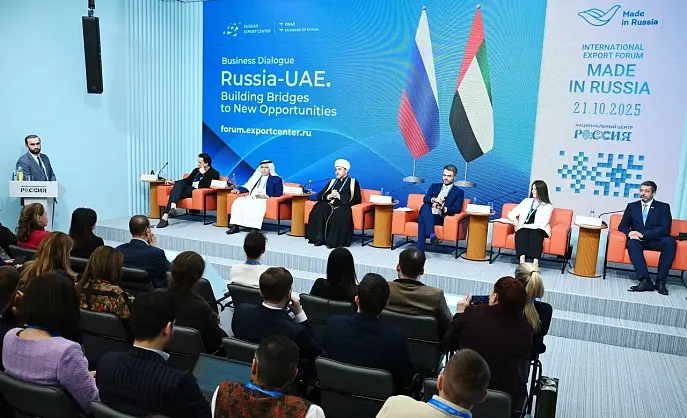
Russian-UAE cooperation is at the top of the foreign trade agenda. The session Russia – UAE: Bridges for New Opportunities became one of the central platforms of the Made in Russia International Export Forum, where representatives of business, government, and expert communities exchanged experiences and identified new areas of cooperation. The forum was organized by Russian Export Center (REC, VEB Group).
Participants discussed new formats of interaction between the countries, development of bilateral trade, investment partnerships, and humanitarian aspects of cooperation.
Najibullah Jabbori, representative of Russian Export Center in the UAE, who emphasized the status of the United Arab Emirates as one of the most open, technologically oriented, and investment-attractive centers in the region, moderated the discussion.
"The UAE remains the region's primary hub for trade, logistics, and investment. Russian companies are increasingly viewing the UAE market not only as a sales outlet but also as a strategic hub for international development. Our goal is to create a sustainable platform where businesses feel confident and see long-term prospects," Najibulloh Jabbori.
Cultural interaction plays a key role in creating a sustainable platform of trust between Russia and the UAE, emphasized Mufti Rushan Abbyasov, Deputy Chairman of the Spiritual Administration of Muslims of the Russian Federation. He noted that Russia and the UAE share a common commitment to spiritual and moral values, the institution of the traditional family, tolerance, and good neighborliness. This creates a favorable atmosphere for building bridges not only between humanitarian interests but also between trade and economic ones. “By developing our horizontal ties through bilateral tourism, mutual acquaintance with the culture and heritage of our peoples, enriching the cooperation agenda, and holding various festivals, events, meetings, and forums, we are creating an ecosystem of trust that stimulates the export of Russian goods, services, and technologies to the Gulf countries, and, most importantly, is positively received by the rather traditional Arab society in this region. At the same time, a transition is necessary from one-off initiatives to institutionalized formats of ongoing interaction: interdepartmental working groups, bilateral centers and platforms for cultural, social, youth, sports and, no less important, spiritual diplomacy.”
Mohamed Kamil Al Muaini, President of the Global Centre for Cultural Communication (GCCC), discussed the role of business and private investment in developing Russian-UAE relations. He emphasized UAE's interest in Russian innovation, particularly in energy, smart cities, industry, and agriculture. "We see great potential for joint technological and manufacturing projects. Russian companies have a strong engineering background, and the Emirates have the resources, infrastructure, and investment. It's a powerful combination."
Evgeny Yelemesov, head of the Russian office of the Dubai Chamber of Commerce and Industry, noted that Russian companies are strengthening their position in the UAE market thanks to quality, innovative approaches, and attention to local culture.
"Today, the Made in Russia brand is becoming increasingly recognizable in the Emirates. This is the result of systematic efforts to promote Russian goods and technologies, as well as the trust built through open dialogue between the countries," he emphasized.
Konstantin Nikolaev, Head of Export Development and Government Relations at Fitocosmetic, shared his successful experience in the UAE market. He emphasized the effectiveness of government export support tools that assist entrepreneurs at every step, from choosing a market and finding a partner to insuring shipments.
Irina Bykhovskaya, partner at B1, focused on corporate governance, compliance, and financial aspects of Russian companies entering the UAE market. She noted that structural changes in the UAE’s business climate make this market particularly attractive to Russian companies. Today, the UAE offers Russian businesses flexible and transparent business mechanisms. A well-designed legal and tax strategy is the key to success for any exporter or investor.”
Alexey Sapozhnikov, CEO of Sapozhnikov & Partners, discussed in detail the legal regimes of Russia and the UAE. They are already becoming increasingly harmonized, and mechanisms to protect investor interests and ensure the sustainability of long-term projects continue to emerge.
Andrey Shket, representative of Skolkovo Foundation, also spoke on the Russian side, discussing opportunities for technology startups. For high-tech companies, the Emirates is not only a sales market but also a venue for joint research and pilot projects.
Made in Russia International Export Forum is a key event of the year for Russian exporters. The Forum is organized by Russian Export Center. The Moscow Government is the business program partner. TASS is the general information partner. RIA Novosti is the exclusive information partner. Information partners include Channel One, Rossiya24, MAER Media, Vedomosti, Expert, Gazprom Media, and Insight People. Roscongress Foundation is the operator of the Forum's business program.
Russian Export Center (REC, VEB Group) is a government institution that supports non-resource, non-energy export. It provides companies from various industries with both financial and non-financial support at all stages of entering international markets, including as part of the International Cooperation and Export national project. Most services offered by the REC Group are available online on My Export digital platform. REC is also responsible for the key functions of supporting and implementing the Made in Russia program.
Participants discussed new formats of interaction between the countries, development of bilateral trade, investment partnerships, and humanitarian aspects of cooperation.
Najibullah Jabbori, representative of Russian Export Center in the UAE, who emphasized the status of the United Arab Emirates as one of the most open, technologically oriented, and investment-attractive centers in the region, moderated the discussion.
"The UAE remains the region's primary hub for trade, logistics, and investment. Russian companies are increasingly viewing the UAE market not only as a sales outlet but also as a strategic hub for international development. Our goal is to create a sustainable platform where businesses feel confident and see long-term prospects," Najibulloh Jabbori.
Cultural interaction plays a key role in creating a sustainable platform of trust between Russia and the UAE, emphasized Mufti Rushan Abbyasov, Deputy Chairman of the Spiritual Administration of Muslims of the Russian Federation. He noted that Russia and the UAE share a common commitment to spiritual and moral values, the institution of the traditional family, tolerance, and good neighborliness. This creates a favorable atmosphere for building bridges not only between humanitarian interests but also between trade and economic ones. “By developing our horizontal ties through bilateral tourism, mutual acquaintance with the culture and heritage of our peoples, enriching the cooperation agenda, and holding various festivals, events, meetings, and forums, we are creating an ecosystem of trust that stimulates the export of Russian goods, services, and technologies to the Gulf countries, and, most importantly, is positively received by the rather traditional Arab society in this region. At the same time, a transition is necessary from one-off initiatives to institutionalized formats of ongoing interaction: interdepartmental working groups, bilateral centers and platforms for cultural, social, youth, sports and, no less important, spiritual diplomacy.”
Mohamed Kamil Al Muaini, President of the Global Centre for Cultural Communication (GCCC), discussed the role of business and private investment in developing Russian-UAE relations. He emphasized UAE's interest in Russian innovation, particularly in energy, smart cities, industry, and agriculture. "We see great potential for joint technological and manufacturing projects. Russian companies have a strong engineering background, and the Emirates have the resources, infrastructure, and investment. It's a powerful combination."
Evgeny Yelemesov, head of the Russian office of the Dubai Chamber of Commerce and Industry, noted that Russian companies are strengthening their position in the UAE market thanks to quality, innovative approaches, and attention to local culture.
"Today, the Made in Russia brand is becoming increasingly recognizable in the Emirates. This is the result of systematic efforts to promote Russian goods and technologies, as well as the trust built through open dialogue between the countries," he emphasized.
Konstantin Nikolaev, Head of Export Development and Government Relations at Fitocosmetic, shared his successful experience in the UAE market. He emphasized the effectiveness of government export support tools that assist entrepreneurs at every step, from choosing a market and finding a partner to insuring shipments.
Irina Bykhovskaya, partner at B1, focused on corporate governance, compliance, and financial aspects of Russian companies entering the UAE market. She noted that structural changes in the UAE’s business climate make this market particularly attractive to Russian companies. Today, the UAE offers Russian businesses flexible and transparent business mechanisms. A well-designed legal and tax strategy is the key to success for any exporter or investor.”
Alexey Sapozhnikov, CEO of Sapozhnikov & Partners, discussed in detail the legal regimes of Russia and the UAE. They are already becoming increasingly harmonized, and mechanisms to protect investor interests and ensure the sustainability of long-term projects continue to emerge.
Andrey Shket, representative of Skolkovo Foundation, also spoke on the Russian side, discussing opportunities for technology startups. For high-tech companies, the Emirates is not only a sales market but also a venue for joint research and pilot projects.
Made in Russia International Export Forum is a key event of the year for Russian exporters. The Forum is organized by Russian Export Center. The Moscow Government is the business program partner. TASS is the general information partner. RIA Novosti is the exclusive information partner. Information partners include Channel One, Rossiya24, MAER Media, Vedomosti, Expert, Gazprom Media, and Insight People. Roscongress Foundation is the operator of the Forum's business program.
Russian Export Center (REC, VEB Group) is a government institution that supports non-resource, non-energy export. It provides companies from various industries with both financial and non-financial support at all stages of entering international markets, including as part of the International Cooperation and Export national project. Most services offered by the REC Group are available online on My Export digital platform. REC is also responsible for the key functions of supporting and implementing the Made in Russia program.