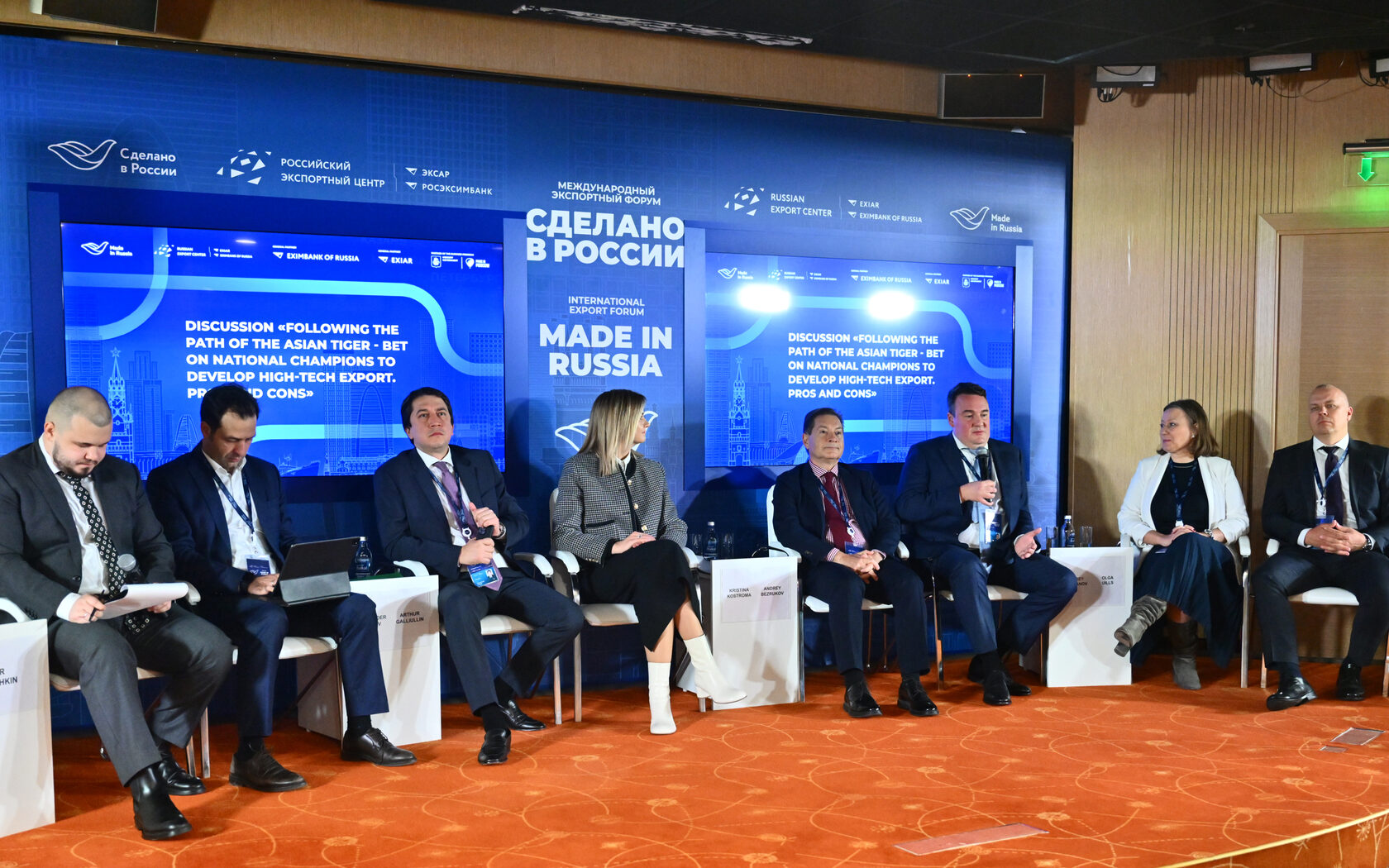
On October 14, as part of the International Export Forum "Made in Russia," organized by the Russian Export Center (part of the VEB.RF Group), a discussion titled "On the Path of the Asian Tiger – Betting on National Champions in the Task of Developing High-Tech Exports: Pros and Cons" took place. While discussing mechanisms of state support and financial instruments for achieving the large-scale task of exporting technological sovereignty, industry experts highlighted examples from other countries' experiences and explored the possibilities of adapting such strategies in Russia.
The session participants unanimously agreed that technological sovereignty is unattainable without leading companies capable of supplying products, services, and technologies to international markets. Sanction restrictions and the protectionist policies of several countries have not only deprived entire sectors of access to foreign technologies but have also complicated exports and "forced" the opening of new markets for Russian goods and services. Experts emphasized that a crucial task today is to saturate the Russian market as much as possible while also seeking new niches for domestic exporters of high-tech products.
In the current conditions, the focus is on innovative approaches and establishing sustainable international supply chains, and the most effective way to implement this model is by supporting so-called "national champion" companies. Examples include tech giants like Samsung, LG, and Hyundai. South Korea has transformed from devastation to a global leader in high-tech and semiconductor industries. A key factor in this success was the active support of the government, including subsidies, low-interest loans, and investments in R&D. The government facilitated the creation of industries and markets, stimulating the export and international development of companies. Russian businesses can leverage such experiences to enter international markets.
Today, one of the most in-demand sectors in the high-tech industry is unmanned aerial systems (UAS), a topic discussed by Pavel Stepanov, Deputy General Director of the Geoscan Group. He noted that it is essential to develop the drone sector, both in terms of production and software, as drones are applied in many areas: for surveying utility infrastructure, delivering goods (including medicines) to remote areas, in the mining industry, agriculture, and in the field of security.
Speaking about the Russian market and its development, Arthur Galiullin, Acting Director of the Department of International Cooperation and Licensing in Foreign Trade at the Ministry of Industry and Trade of Russia, emphasized that the country needs to create national champions and, most importantly, provide support across all areas, including helping them enter international markets. The main task is to create favorable conditions.
All participants in the session were in agreement that creating export-oriented high-tech industries is undoubtedly a good initiative that drives the development of technological sovereignty and, in some respects, technological leadership in the country. Russia has many strong players and promising startups that create competitive products capable of competing in international markets. However, to achieve the successes of Asian counterparts, state support is crucial.
The organizer of the International Export Forum "Made in Russia" is the Russian Export Center (part of VEB.RF). General partners include EXAR and ROSEXIMBANK. The business program partner is the Government of Moscow. The operator of the forum's business program is the Roscongress Foundation.
The information partners of the Forum include: RBC, Russia 24, RT, Mir, Izvestia, TV BRICS, Business FM, Moscow 24, RIA Novosti, Interfax, Kommersant, Russian Newspaper, Expert, News.ru, Small Business of Moscow, FederalPress, Bulletin of the Agro-Industrial Complex, Bulletin of the Economy, as well as Sudostroenie.info.
The session participants unanimously agreed that technological sovereignty is unattainable without leading companies capable of supplying products, services, and technologies to international markets. Sanction restrictions and the protectionist policies of several countries have not only deprived entire sectors of access to foreign technologies but have also complicated exports and "forced" the opening of new markets for Russian goods and services. Experts emphasized that a crucial task today is to saturate the Russian market as much as possible while also seeking new niches for domestic exporters of high-tech products.
In the current conditions, the focus is on innovative approaches and establishing sustainable international supply chains, and the most effective way to implement this model is by supporting so-called "national champion" companies. Examples include tech giants like Samsung, LG, and Hyundai. South Korea has transformed from devastation to a global leader in high-tech and semiconductor industries. A key factor in this success was the active support of the government, including subsidies, low-interest loans, and investments in R&D. The government facilitated the creation of industries and markets, stimulating the export and international development of companies. Russian businesses can leverage such experiences to enter international markets.
Today, one of the most in-demand sectors in the high-tech industry is unmanned aerial systems (UAS), a topic discussed by Pavel Stepanov, Deputy General Director of the Geoscan Group. He noted that it is essential to develop the drone sector, both in terms of production and software, as drones are applied in many areas: for surveying utility infrastructure, delivering goods (including medicines) to remote areas, in the mining industry, agriculture, and in the field of security.
Speaking about the Russian market and its development, Arthur Galiullin, Acting Director of the Department of International Cooperation and Licensing in Foreign Trade at the Ministry of Industry and Trade of Russia, emphasized that the country needs to create national champions and, most importantly, provide support across all areas, including helping them enter international markets. The main task is to create favorable conditions.
All participants in the session were in agreement that creating export-oriented high-tech industries is undoubtedly a good initiative that drives the development of technological sovereignty and, in some respects, technological leadership in the country. Russia has many strong players and promising startups that create competitive products capable of competing in international markets. However, to achieve the successes of Asian counterparts, state support is crucial.
The organizer of the International Export Forum "Made in Russia" is the Russian Export Center (part of VEB.RF). General partners include EXAR and ROSEXIMBANK. The business program partner is the Government of Moscow. The operator of the forum's business program is the Roscongress Foundation.
The information partners of the Forum include: RBC, Russia 24, RT, Mir, Izvestia, TV BRICS, Business FM, Moscow 24, RIA Novosti, Interfax, Kommersant, Russian Newspaper, Expert, News.ru, Small Business of Moscow, FederalPress, Bulletin of the Agro-Industrial Complex, Bulletin of the Economy, as well as Sudostroenie.info.