Today, many countries are developing comprehensive regulations for digital currencies: requirements for compliance, operational transparency, provider licensing, and protection of market participants. All are united by a common trend toward integrating crypto instruments into the economic system, Angelina Akimenko, Managing Director for Advanced Financial Technologies, EXIMBANK OF RUSSIA (part of the REC Group) announced on the sidelines of the Made in Russia International Economic Forum.
“The trend toward digitalization is particularly active in the Asia-Pacific region, where Singapore, Hong Kong, and the UAE have already established special regulatory regimes for digital assets. Many countries are developing comprehensive regulations for digital currencies: requirements for compliance, operational transparency, provider licensing, and protection of market participants. Despite the differences in countries’ approaches, a common trend is observed, which is a shift from a complete ban or ignoring of crypto instruments to attempts to integrate them into the economic system with clear rules,” Angelina Akimenko at Digital Finance for Foreign Economic Activity session.
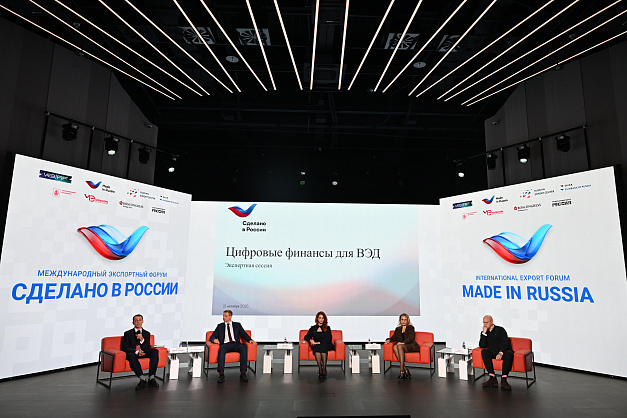
At the session, experts discussed how digital tools, including those for international settlements, are becoming increasingly clear and structured. Against a backdrop of geopolitical turbulence, sanctions restrictions, and technological advances, participants in foreign economic activity (FEA) around the world are actively seeking new forms of financing, payments, and data exchange. More and more companies are turning to solutions that ensure independence from traditional financial infrastructure and enhance the resilience of international business.
The discussion was attended by Sergey Otvodenkov, Director for Strategic and Financial Development at DALKOS, Olga Goncharova, Head of the Expert Center for Digital Financial Assets and Digital Currencies at the Association of Banks, and Dmitry Machikhin, Development Director at BitOK. Andrey Mikhailishin, CEO of BRICS Pay, moderated the discussion.
Speakers highlighted payments using digital assets, primarily stable coins, as a key area in the industry. Thanks to their transparency, link to real assets, and low transaction costs, stable coins form the foundation for a new global payments ecosystem. They can ensure fast and transparent payments between companies from different jurisdictions, bypassing correspondent account restrictions and complex banking procedures. “The development of stable coins among friendly countries creates the foundation not only for trade and economic independence, but also for digital integration, enabling the transition to new business models in logistics, energy, industry, and e-commerce,” Angelina Akimenko.
She noted that, upon request from foreign trade participants, EXIMBANK OF RUSSIA provides assistance in the use of alternative financial instruments in full compliance with current regulations in Russia.
“The trend toward digitalization is particularly active in the Asia-Pacific region, where Singapore, Hong Kong, and the UAE have already established special regulatory regimes for digital assets. Many countries are developing comprehensive regulations for digital currencies: requirements for compliance, operational transparency, provider licensing, and protection of market participants. Despite the differences in countries’ approaches, a common trend is observed, which is a shift from a complete ban or ignoring of crypto instruments to attempts to integrate them into the economic system with clear rules,” Angelina Akimenko at Digital Finance for Foreign Economic Activity session.
At the session, experts discussed how digital tools, including those for international settlements, are becoming increasingly clear and structured. Against a backdrop of geopolitical turbulence, sanctions restrictions, and technological advances, participants in foreign economic activity (FEA) around the world are actively seeking new forms of financing, payments, and data exchange. More and more companies are turning to solutions that ensure independence from traditional financial infrastructure and enhance the resilience of international business.
The discussion was attended by Sergey Otvodenkov, Director for Strategic and Financial Development at DALKOS, Olga Goncharova, Head of the Expert Center for Digital Financial Assets and Digital Currencies at the Association of Banks, and Dmitry Machikhin, Development Director at BitOK. Andrey Mikhailishin, CEO of BRICS Pay, moderated the discussion.
Speakers highlighted payments using digital assets, primarily stable coins, as a key area in the industry. Thanks to their transparency, link to real assets, and low transaction costs, stable coins form the foundation for a new global payments ecosystem. They can ensure fast and transparent payments between companies from different jurisdictions, bypassing correspondent account restrictions and complex banking procedures. “The development of stable coins among friendly countries creates the foundation not only for trade and economic independence, but also for digital integration, enabling the transition to new business models in logistics, energy, industry, and e-commerce,” Angelina Akimenko.
She noted that, upon request from foreign trade participants, EXIMBANK OF RUSSIA provides assistance in the use of alternative financial instruments in full compliance with current regulations in Russia.